
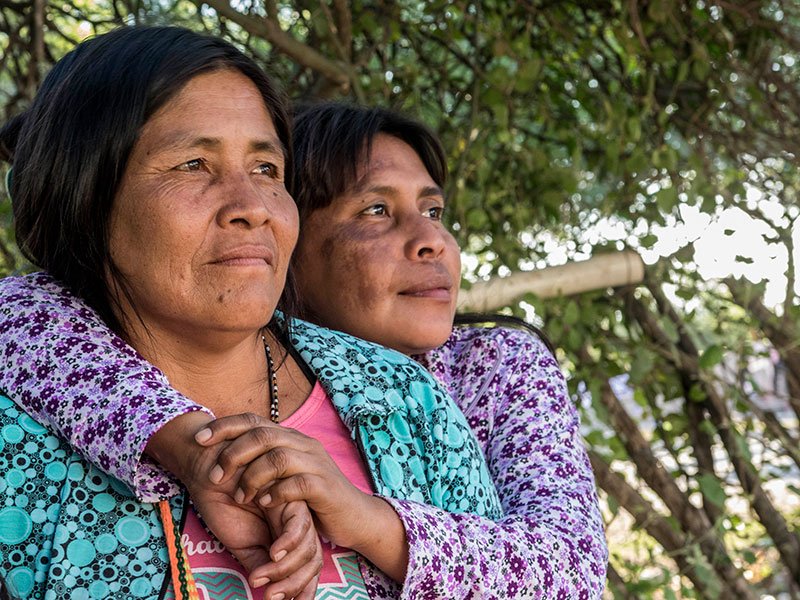
The word ‘Niyat’ refers to the name Wichí the traditional leader, which represents a guide and based his leadership on knowledge and the ability to guide the group to the risks and difficulties that you are facing.
There could not be a more appropriate word to refer to the new project that we have helped to launch in Argentina, funded by the European Union and implemented by the Foundation Gran Chaco in coordination with the Network of Rural Communities (RCR), the Cooperative of Rural Women (COMAR), the area of gender of the Latin american Faculty of Social Sciences (Flacso), the international organization Slow Food and the Ministry of Social Development of the Nation-MDS.
‘Niyat, the leader Wichí, -explains Fabiana Menna, project coordinator for the Foundation Gran Chaco – it has more of a concept guide and is not hereditary, as became the chieftain, the current authority recognized by the argentine State. The leader or leader traditional Wichí is a person who has wisdom, that knows how to direct and guide your group and it is often a young person, then it changes and passes his leadership to another person, which is based on the personal prestige, and not in an inheritance. When we speak of indigenous leadership, we talk about other ways of thinking about leadership, the more horizontal, flexible, variable, inclusive and do not necessarily masculine.’
A new indigenous governance
The protagonists of the program, in fact, are in first place of the women, but also young people and the aboriginal communities: the project NIYAT aims to strengthen its role to generate a new indigenous governance for the co-design of public policies based on rights in the rural areas of the Gran Chaco of Argentina. The goal is to promote indigenous leadership to promote a process of inter-institutional articulation to strengthen the communities as a subject local protagonist of the interventions in its territory, in dialogue with the State.
The objectives of the project, presented by its coordinator, Fabiana Menna
In the development of the activities, it will be fundamental to the role of local associations that will be implemented by different concrete actions in the 24 indigenous communities of the provinces of Salta, Chaco, and Formosa, which are part of the co-Op of Artisan Women of the Gran Chaco-COMAR.
‘In COMAR -explains Norma Rodriguez, president of the cooperative, a member of the Wichí people – there are 2000 artisans partners, and many more who work with us even without being still associated. We have many challenges to face: women, like me, work a lot because we have our handicrafts which have a market, but the men do not have a job. Be a part of this project, and also be a partner in this collaboration with the Fundación Gran Chaco, that is supporting us, it is important for us because we are not in the city, we are in the communities and it is sometimes difficult to know over other people. There are times that it gets complicated because we live far away and now, thanks to projects that help us to connect, for example with the internet, we can communicate with other people living in other countries.”
In effect, the conditions of vulnerability that are these communities due to the difficulty of access to goods essential for their development. In fact, the indigenous communities do not have access to the educational system in the same proportion as the rest of the boys and girls in argentina and are not provided with Information and Communication Technologies -ICT – appropriate. This situation is aggravated by the high rates of food insecurity.
Through the project, in addition to strengthening the management capacity of indigenous communities, through the installation of Committees of Management with Local participation in the construction of public policies, the participants will consolidate learning communities to promote the right to a comprehensive education, bilingual and intercultural and gender-sensitive and will improve the food security of their communities, traditional production systems based on local knowledge and biodiversity.
‘The project responds primarily to the need to build public policies that are driven from indigenous communities, and that are effective.’ – says Fabiana Menna. “The indigenous communities of Chaco, Salta and Formosa, and of all the regions in general, live in conditions of high vulnerability, high food insecurity and lack of access to human rights in general. Many times, from the State, there is a whole series of programs and investments, but they are with multiple barriers so that they can generate a process of endogenous development. Then, from the project NIYAT we aim precisely to the fact that these policies are co-designed, or be designed in collaboration between civil society, the same communities and the State. We believe that it is the only way to really get investment can be long-lasting, sustainable and inclusive’.
As well, some of the key words of the project will be “dialogue and inclusion”, in an effort to understand the different perspectives of the communities and to strengthen their leadership capabilities, autodeterminando your own future.
‘Often concludes Fabiana Menna – one of the barriers to the construction of public policies in conjunction with indigenous communities is the high level of fragmentariness of the communities in the region of the Gran Chaco, which are traditionally hunters and gatherers organized with a structure in the band. Unlike other peoples, communities of the Gran Chaco never have come to form organizations large and structured. In fact, because of its flexibility and social policy have been referred to by many authors as a society without a State. Its structure is based on the extended family, formed by groups of around fifty people, and today the community is a sum of several of these extended families. Hence the big fragmentariness of the leadership and many times the difficulty of having a single interlocutor. That’s why, for us it has been very important and significant that the co-Op of Artisan Women of the Gran Chaco (COMAR) is an active agent of the project, since it is integrated by women of the peoples Wichí, Qomle’ec and Pilagá’.